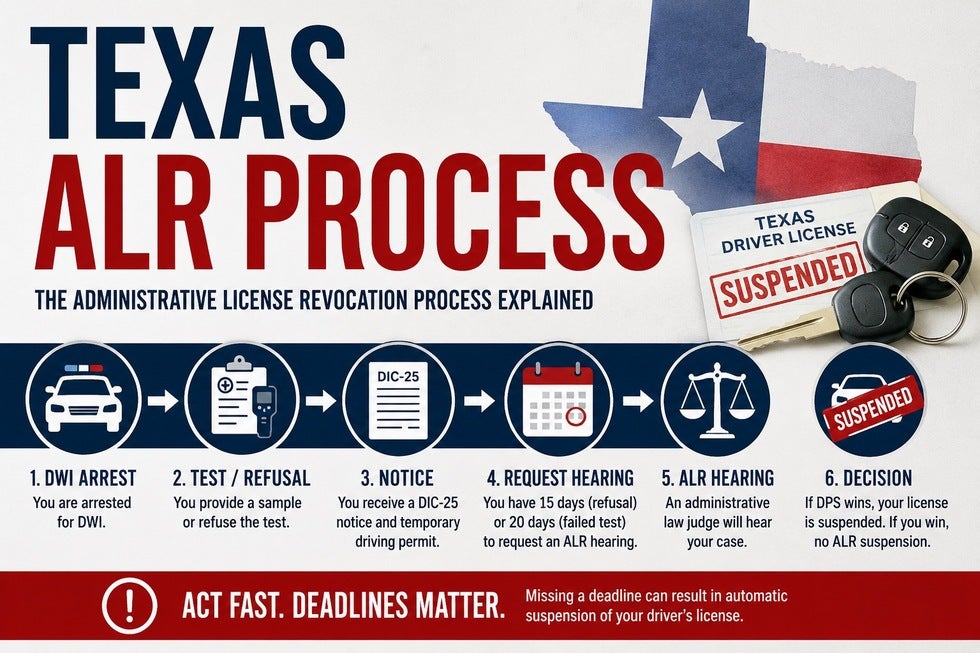
If you're arrested for Driving While Intoxicated (DWI) in Texas, one of the immediate consequences involves your driver's license. Texas uses an Administrative License Revocation (ALR) program, a civil process managed by the Texas Department of Public Safety (DPS) that can suspend your driving privileges separately from any criminal DWI case. This administrative action often feels “automatic,” but it includes opportunities to challenge it.
How the ALR Process Begins
During a DWI investigation, an officer may request a breath or blood test to measure your blood alcohol concentration (BAC). Texas has an “implied consent” law: by holding a driver's license, you agree to provide a sample when lawfully asked.
- If you refuse the test, or
- If you take the test and your BAC is 0.08% or higher (or 0.04% for commercial drivers),
the officer will confiscate your driver's license and issue a Notice of Suspension (often on form DIC-25). This notice also serves as a temporary driving permit, typically valid for 40 days from the date of arrest.
The ALR process is independent of your criminal court case. Your license can be suspended even if the DWI charge is later dismissed or you are acquitted.
The Critical 15-Day Deadline
You have only 15 days from the date the notice is served (usually the arrest date) to request an ALR hearing with the DPS. This is a strict deadline with no extensions.
- Request the hearing online through the DPS website ALR Hearing Request, by mail, call DPS at
(800) 394-9913, or other approved methods.
- Include your name, date of birth, driver's license number, arrest details, and contact information.
If you request a hearing on time, your temporary permit usually remains valid until the hearing decision. If you miss the deadline, your license is automatically suspended on the 40th day after the notice, with no further right to contest the ALR action at that stage.
What Happens at an ALR Hearing?
The ALR hearing is an administrative proceeding before a DPS hearing officer (not a criminal court judge). It typically focuses on a few key issues:
- Was there reasonable suspicion or probable cause for the stop and arrest?
- Was the request for a chemical test properly made?
- Did you refuse the test, or did you fail it (BAC ≥ 0.08%)?
The hearing is relatively informal and can occur by phone, video, or in person. The DPS must prove its case by a preponderance of the evidence. If the officer does not appear or the evidence is insufficient, the suspension may be lifted. An unfavorable ruling can be appealed, but the process moves quickly. See additional information from the State Office of Administrative Hearings (SOAH).
Length of Suspension
Suspension periods depend on whether you failed or refused the test and your driving history (within the prior 10 years):
- First offense – Failed test: Typically 90 days.
- First offense – Refusal: Typically 180 days.
- Repeat offenses: Suspensions can extend to 1 or 2 years.
These are administrative periods. A separate criminal conviction can trigger additional or overlapping suspensions (up to 1 year for a first DWI conviction, up to 2 years for subsequent ones). Minors and commercial drivers face different rules.
Even after the suspension ends, you must pay a reinstatement fee, provide proof of insurance (SR-22), and may need to complete an alcohol education program or install an ignition interlock device to regain full driving privileges.
Important Considerations
The ALR process is fast-moving and separate from your criminal defense. Winning the ALR hearing does not dismiss the DWI charge, but losing it can complicate your life—impacting work, family, and daily activities. Many drivers successfully challenge suspensions by timely requesting a hearing and presenting strong evidence.
This information is for educational purposes only and is not legal advice. DWI laws are complex, and outcomes depend on specific facts. Consult a qualified Texas DWI attorney immediately after an arrest to protect your rights, meet deadlines, and explore all defense options, including ALR hearings and potential
driver's licenses.
Acting quickly within those first 15 days can make a significant difference in preserving your driving privileges while your criminal case proceeds.